Air Line Lubricators
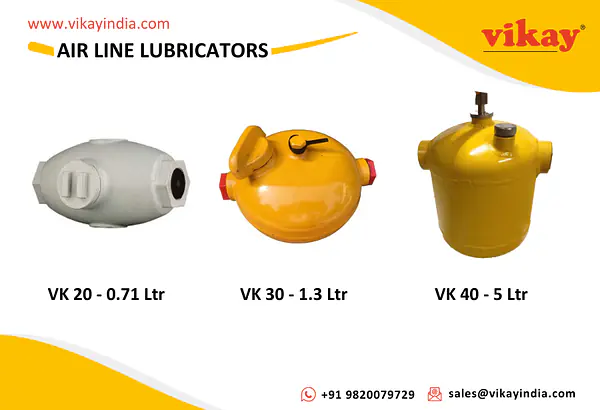
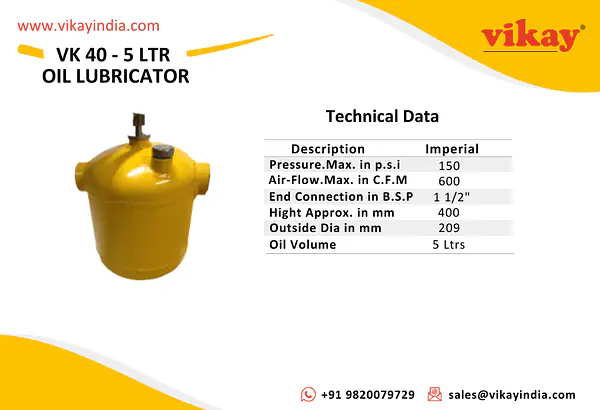
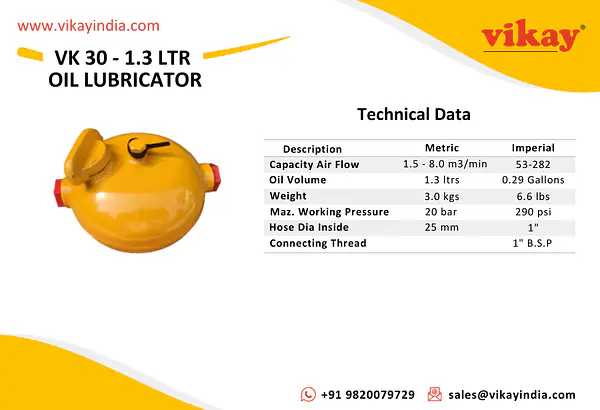
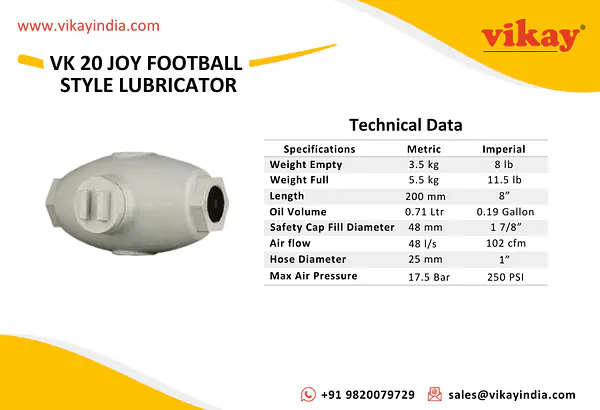
An air line lubricator meters oil into the compressed air supply so it reaches the piston and cylinder of a pneumatic tool. Vikay supplies in-line lubricators from India in 0.71 litre, 1.3 litre (VK 30) and 5 litre (VK 40) capacities.
Percussive air tools have no oil sump. The only lubrication a
rock drill or breaker receives is the oil carried in the air stream, and running one dry is the fastest way to destroy a piston and cylinder. An in-line lubricator sits in the hose upstream of the tool and meters oil continuously while air flows.
Capacity is chosen by how long the tool must run between refills and how far the lubricator sits from the operator. The 0.71 litre unit suits a single hand-held drill working close by; the 1.3 litre VK 30 covers a longer shift; the 5 litre VK 40 suits a manifold feeding several tools or a position that is awkward to reach for refilling.
Units correspond in duty to the Atlas Copco BLG 30 and CLG 30 class and connect into standard air hose lines.
FAQS
Why does a pneumatic tool need an air line lubricator?
- Because percussive air tools have no oil reservoir of their own. The only lubrication the piston and cylinder receive comes from oil carried in the compressed air, so an in-line lubricator is what prevents rapid wear or seizure.
Which capacity should I choose?
- Match it to run time and access. 0.71 litre for a single tool close at hand, 1.3 litre (VK 30) for a full shift, and 5 litre (VK 40) for a manifold feeding several tools or a position that is hard to refill.
Where should the lubricator be fitted?
- In the air line upstream of the tool, as close to it as practical. Long hose runs downstream of the lubricator reduce how much oil actually reaches the tool.