DTH Hammers
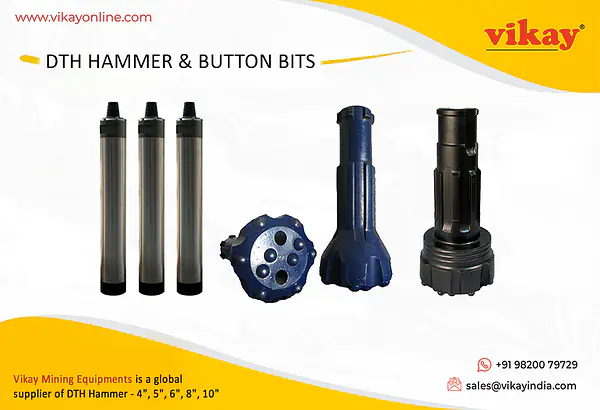
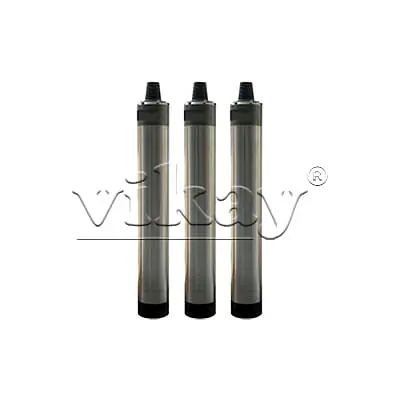
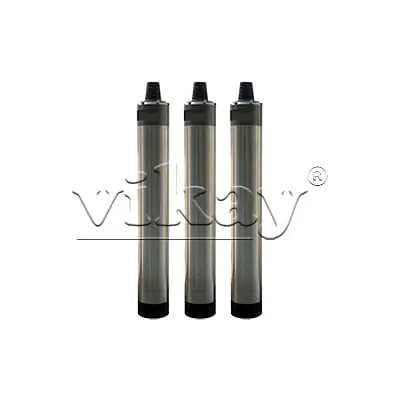
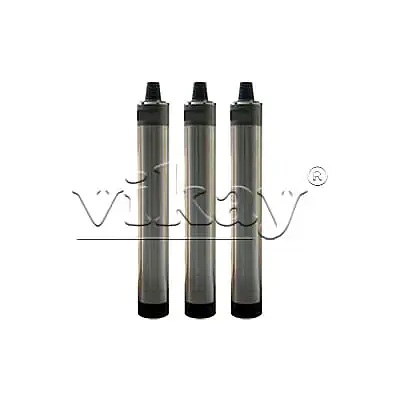
A down-the-hole (DTH) hammer is a percussive drilling tool that travels at the bottom of the hole directly behind the bit, driven by compressed air down the drill string. Vikay supplies DTH hammers from India in 4, 5, 6, 8 and 10 inch sizes.
Placing the hammer at the bottom of the hole is what distinguishes DTH from top-hammer drilling. Impact energy passes straight into the bit instead of travelling down a rod string through threaded joints, so penetration rate holds up as the hole deepens and deviation stays low. Exhaust air from the hammer flushes cuttings up the annulus.
The range covers VD40D x 98 in 4 inch; VD50S x 106 and VD55S x 112 in 5 inch; VD60D x 148, VD60S x 142, VD60S x 148 and VD65M x 148 in 6 inch; VD80D x 177 and VD80S x 177 in 8 inch; and VD10S x 225 in 10 inch.
Applications include open-cast mining, granite and marble quarrying, construction blast holes, water well drilling and foundation piling. Matching bits in BR2, BR3, DHD, SD, QL, M-series, SVE and Panther shanks are listed under
Drill Bits.
FAQS
What is a DTH hammer and how does it work?
- It is a pneumatic percussion unit that runs at the bottom of the hole immediately behind the bit. Compressed air fed down the drill pipe drives the piston, and the exhaust air flushes cuttings to surface.
When is DTH better than top hammer drilling?
- In deeper holes, larger diameters and wherever hole straightness matters. Because energy does not pass through rod joints, penetration rate and accuracy degrade far less with depth.
What sizes are available?
- 4, 5, 6, 8 and 10 inch hammers, covering the common blast hole, quarry and water well diameters, with matching bits available in the standard shank types.